#2: Why Communicating Your Needs Can Feel Hard (& How to Do It with Confidence + Calm)
I was recently talking with women inside my mindset community, and a familiar theme came up:
Why is it so hard to communicate what we actually need?
Even when we know a boundary is necessary or that a simple “no” would be the healthiest response, it can feel uncomfortable to speak up. We worry about sounding harsh. We worry about disappointing someone. We worry about how we’ll be perceived.
And often, we stay silent.
You know the moments:
A family member offering unsolicited advice you didn’t ask for
A colleague repeatedly scheduling over your already-full calendar
A friend dropping by unannounced when your capacity is already stretched thin
Sound familiar? You’re not alone.
For many high-achieving, thoughtful women, the struggle isn’t knowing what we need. It’s giving ourselves permission to say it out loud.
A quiet truth about people-pleasing
There have been seasons in my life where I avoided communicating my needs because I was afraid of the outcome. Afraid of tension. Afraid of being misunderstood. Afraid of losing approval or connection.
At the root of it was this belief:
If I’m honest about what I need, someone might be upset with me.
But here’s the truth most people-pleasers need to be reminded of:
You are not responsible for how someone feels about a boundary you communicate respectfully.
That part is uncomfortable, I know. Especially if you’re wired for harmony and connection. But avoiding boundaries doesn’t protect relationships, it slowly erodes them. Over time, unspoken needs turn into resentment, exhaustion, and burnout.
That’s not the life you’re meant to live.
What actually happens when you communicate clearly
When I began expressing my needs honestly and consistently, something unexpected happened. My relationships didn’t weaken—they became healthier and more genuine. Some people were unsettled at first, but they weren’t the closest relationships; I realized my lack of boundaries had once been convenient for them. The ones who valued me for who I truly am stayed, and those connections grew stronger, built on truth, respect, and mutual understanding.
And internally? I experienced more peace. Less resentment. Less mental load.
Here’s a reframe that helps:
Think of setting a boundary as releasing something.
Once it’s expressed, your responsibility ends there.
Your role: communicate clearly and kindly
Their role: decide how they respond
You don’t need to manage both.
A perspective shift worth considering:
Imagine someone in your life said “yes” to you, not because they had the capacity, but because they didn’t feel allowed to say no. Maybe they were overwhelmed, navigating a new season, or simply needed rest.
Would you want that? Probably not.
Most of us would respond with understanding and even respect.
So why do we struggle to offer ourselves that same compassion?
The good news…
Communicating your needs does not require confrontation, over-explaining, or guilt. There are simple, respectful, and effective ways to say what you need while staying grounded and kind.
And when you practice them, something shifts. You begin to trust yourself. You begin to feel calmer. You begin to lead your life with intention instead of pressure.
A small but powerful win for today
Below are a few real-life scripts you can use as a starting point. Save them. Screenshot them. Come back to them when you need support.
“I’m not available for that right now, but thank you for thinking of me.”
“That doesn’t work for my schedule, I’ll let you know if that changes.”
“I’m focusing on fewer commitments in this season.”
“I need some space around this right now.”
“I’ll think about it and let you know if I can commit to that.”
No apology required. No justification necessary.
You’re not being difficult.
You’re being clear.
And clarity is a form of kindness, for you and for others.
There are remarkable, straightforward ways to communicate your needs to others in a loving, supportive, and direct way.
Today, I want to share a handful of scenarios/responses with you, in hopes that you can feel more confident and equipped to communicate your needs in a kind but firm way.
*Feel free to save this graphic on your phone, and bookmark it for easy access when you need to reference it!
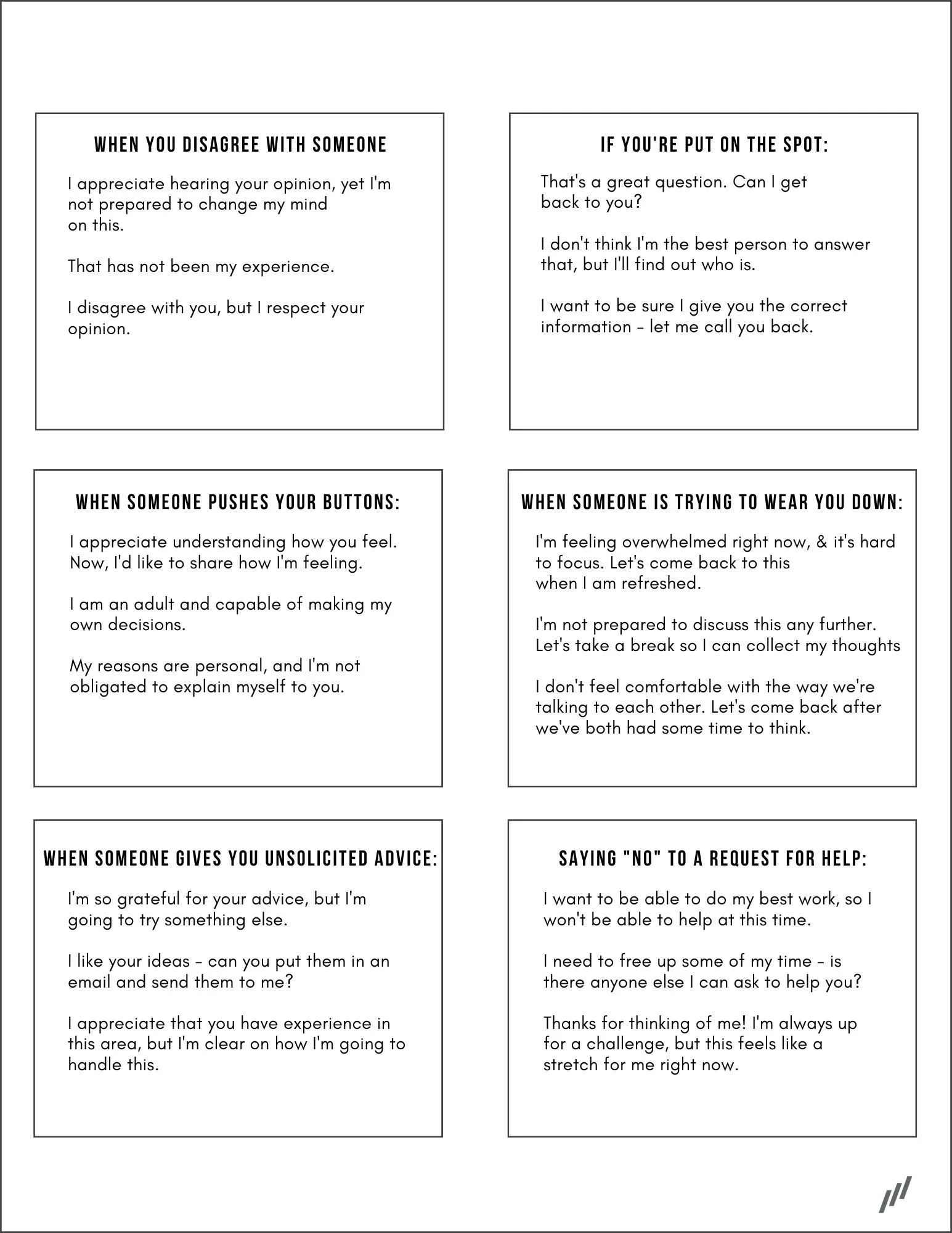
If communicating your needs feels hard, it’s rarely about not knowing what to say.
It’s usually about not being fully anchored in who you are and what actually matters to you right now.
When you lack clarity around your identity, priorities, and season of life, boundaries can feel heavy, awkward, or even selfish. But when you’re aligned with yourself, boundaries become simpler. Calmer. More natural. They stop feeling like something you’re forcing and start feeling like something you’re honoring.
That deeper alignment is exactly what I guide women through inside The Aligned Method.
This is where we move beyond surface-level tools and into sustainable clarity. Over our weeks together, we slow down and do the foundational work most high-achieving women have never been given space to do: clarifying
The Aligned Method isn’t about fixing yourself.
It’s about returning to yourself.
If you’re ready to stop managing your life from pressure and start living from alignment, this experience may be your next step.
Enrollment opens a few times each year.
👉 You can join the waitlist here to be the first to know when doors open.
For now, I hope this guide supports you in practicing clear, healthy communication with more confidence and self-trust. And if you’d like to stay connected or ask a question, I’m always sharing and connecting over on Instagram. I’d love to continue the conversation there.